
Asphalt shingles cover most of the homes we work on in Dallas-Fort Worth, Austin and San Antonio, and for good reason. They are affordable, every roofer in Texas knows how to install them, they come in dozens of colors, and when a section gets damaged it can be repaired without replacing the whole roof. But "a shingle roof" covers a wide range of products, and the difference between them matters a lot more in Texas than it does in most of the country.
This page walks through the choices you will actually face when you replace a shingle roof with Viva Roofing: the type of shingle, whether an impact-rated product is worth it on your house, how the Texas sun affects the decision, and how to pick a color you will still like in fifteen years. We are a family-owned roofing company based in Frisco, working since 2021, and Mike Zhukov is personally involved in the jobs we take on. We install shingles from major manufacturers, and we will put the options side by side on a written estimate so you can compare them on your own roof rather than on a brochure.
Every shingle job starts the same way: a free roof inspection. We get on the roof, photograph what we find, and show you the photos. Customers mention the before-and-after drone photos of their own roof in their reviews; it is often the first time they have really seen it.
- Free inspection with photos. You see what we see before you decide anything.
- Written estimate before work starts. The shingle line, the color and the scope are on paper.
- Standard and Class 4 options. We can price an impact-resistant shingle beside a standard one.
The Three Kinds of Asphalt Shingle
Almost every asphalt shingle sold today falls into one of three groups. They are all made the same basic way, a mat coated in asphalt and topped with ceramic-coated granules, but they differ in thickness, shape and how much punishment they are built to take.
3-tab shingles
The 3-tab is the original flat shingle: a single layer cut into three tabs so that, once installed, it looks like a grid of evenly sized rectangles. It is the lightest and thinnest option and usually the least expensive. On a rental, a house you plan to sell soon, or a detached shed it can make sense. The trade-off is that a single layer has less material to absorb a hailstone and less weight to hold it down in wind, and the flat, uniform look reads as dated on many newer homes. If a quote you have received lists "3-tab" and you were expecting something heavier, ask about it.
Architectural (dimensional) shingles
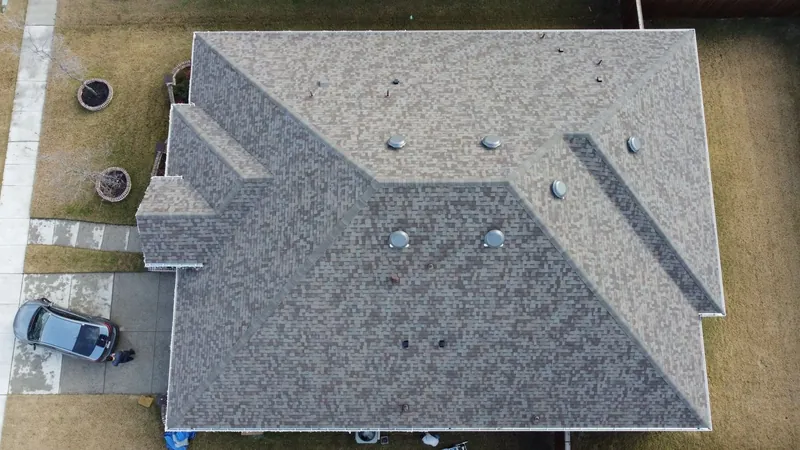
Architectural shingles, also called dimensional or laminated shingles, are built from two or more layers bonded together. The extra layer gives the roof a textured, shadowed look that resembles wood shake from the street, and it adds thickness and weight. That extra material is why architectural shingles generally hold up better to wind and everyday wear than 3-tab. For most homes in north Texas and central Texas, an architectural shingle is the sensible default, and it is what you see on the finished roof in the photo above. When we write up a shingle replacement, this is the baseline we usually start from.
Class 4 impact-resistant shingles
Impact-resistant shingles look much like architectural shingles from the ground, but they are made to take a harder hit. Depending on the product, that can mean a reinforced backing, a rubber-modified (SBS) asphalt that flexes on impact instead of cracking, or both. "Class 4" refers to the highest rating under UL 2218, a standard laboratory test for roof coverings. In that test a two-inch steel ball is dropped from twenty feet onto the same spot of the shingle twice, and to earn Class 4 the shingle cannot crack, split or rupture. Customers have chosen a Class 4 shingle for their replacement with us, and it is worth a conversation on any house in hail country.
Why the Impact Rating Matters in Texas
Hail is the single biggest reason shingle roofs in our service area get replaced early. North Texas sits in one of the most hail-prone parts of the United States, and the storm that came through northeast San Antonio on September 11, 2026 is a reminder that central and south Texas are not immune either. A standard shingle that takes a direct hit from a large stone can lose its granules in a bruise-shaped spot, crack along the mat, or get knocked loose at the seal strip. Those spots are often invisible from the yard, which is why we photograph the roof up close during every inspection.
An impact-rated shingle does not make a roof indestructible, and we will not tell you it does. Hail larger than the test ball, wind-driven hail, and repeated storms in one season can still damage a Class 4 roof. What the rating gives you is a better chance that an ordinary hailstorm leaves the roof doing its job. For a lot of Texas homeowners that is worth the higher upfront price, and here is one more reason to look at it: the Texas Department of Insurance explains that insurers can give a premium credit for roof coverings rated under UL 2218, with the amount set by each insurance company. Whether your insurer offers one, and how much, is a question for your insurance agent, and it is worth asking before you choose.
If you are already sure you want a standard architectural shingle, that is a perfectly reasonable choice too. We will price both so the difference is a real number on your house and not a guess.
Heat, Sun and Ventilation
Texas summers are hard on asphalt. The roof deck on a dark shingle roof gets far hotter than the air temperature, and that heat slowly bakes the oils out of the asphalt, which is part of why older shingles turn brittle and start shedding granules. A few things on a shingle job make a real difference to how long the roof stays healthy in that heat:
Attic ventilation
Air needs to come in low, at the soffits, and leave high, at the ridge or through roof vents. When that balance is off, heat and moisture build up in the attic and cook the shingles from underneath. During the inspection we look at the existing vents and the soffits, and if the ventilation is clearly short, we will say so on the estimate rather than quietly roofing over the problem.
Underlayment
Under the shingles sits a layer of underlayment, the roof's second line of defense if water ever gets past a shingle. On our replacements this is typically a synthetic underlayment, which holds up better to heat and foot traffic during installation than the old felt paper. You can see what that layer looks like on our new roof installation page.
Granules and color
The colored granules on the surface of a shingle protect the asphalt from ultraviolet light. Some product lines also offer reflective or "cool roof" versions with granules designed to bounce back more sunlight. They are worth asking about on a house with a hot upstairs, though the effect depends on the attic and insulation as much as the shingle.
Choosing a Shingle Color
Color is the part of a shingle replacement people enjoy most and second-guess most. A few practical points help:
- Look at it on a house, not a sample board. A small sample looks darker in your hand than a whole roof does from the street. Drive past a finished roof in the color you are considering if you can.
- Match the fixed parts of the house. Brick, stone and trim are not changing. Pick a color that works with them, especially on a brick or stone house.
- Lighter colors run cooler. A lighter gray or weathered wood tone absorbs less heat than a near-black shingle, which matters in a Texas summer.
- Check with your HOA first. Many neighborhoods in the Dallas-Fort Worth suburbs have rules about roof color or require approval before a replacement. Get that approval in hand before the shingles are ordered.
Gray tones are popular for a reason: they go with most brick and stone, they hide dust and streaking well, and they tend to stay in style. The roof in the photo above is a good example.
What a Shingle Replacement With Viva Looks Like
The steps are the same whether you are replacing an old roof or a hail-damaged one:
- Free inspection. We inspect and photograph the roof, including close-ups of any damage and, where it helps, drone shots of the whole roof.
- Written estimate. You get the shingle line, the color, the underlayment and the scope in writing. If you want to compare standard and Class 4, both go on the estimate.
- Choosing the product. We help you settle on the shingle and color, and you check them against your HOA rules if you have them.
- Tear-off and installation. Our crews remove the old shingles down to the decking, replace any rotten or damaged decking, lay underlayment, and install the new shingles, flashing and ridge cap.
- Cleanup and walkthrough. We clean up the property, and show you the finished roof, often with before-and-after drone photos.
If your shingles were damaged in a storm and you have an insurance claim, the process is similar. You file the claim with your insurer; we provide the inspection photos and work from your adjuster's approved scope. The claim itself is between you and your insurance company. Our insurance claim roofing page explains that side in more detail, and our hail and storm damage page covers what to do right after a storm.
Repair or Replace a Shingle Roof?
Not every damaged shingle roof needs to be replaced. A few missing shingles after a windstorm, a lifted ridge cap, or a leak around a single pipe boot can usually be fixed, and we would rather tell you that than sell you a roof you do not need. Widespread hail bruising, brittle shingles that crack when lifted, heavy granule loss, or a roof that has been patched over and over are different stories. The inspection photos make the call for you: you will see the same thing we see. For small problems, start with our roof repair page; for a full tear-off, see roof replacement.
If you are weighing shingles against something else entirely, our metal roofing page compares the two honestly, including where shingles still make more sense.
Paying for a New Shingle Roof
Your estimate is written and itemized before any work starts, so you know what you are agreeing to. If paying for the roof all at once is a stretch, financing is available on approved credit through a third-party lending partner. Ask about it during the estimate and we will walk you through how it works.
Why Homeowners Choose Viva for Shingle Roofs
- Family-owned and local. A Texas company with its office in Frisco, serving Dallas-Fort Worth, Austin and San Antonio since 2021.
- The owner is involved. Customers mention Mike by name in their reviews, for answering the phone and walking them through their roof.
- Honest about the options. No upselling. If a standard architectural shingle is the right call, we will say so, and if Class 4 is worth a look, we will show you the price difference.
- Photos of your own roof. Close-ups and drone shots before and after, so you can see the work and not just take our word for it.
- 5.0 stars on Google. From 63 reviews, with fair pricing and responsiveness as the themes customers bring up most.
Ready to see what shape your shingles are in? Call us or request your free inspection, and we will set a time to come out.