
Most of what Viva Roofing does is residential: shingle roofs on homes across Dallas-Fort Worth, Austin and San Antonio. But plenty of buildings do not fit neatly into "house with a pitched roof." A large home with flat sections over a patio or a wing, a small office or retail building, a fourplex or a small apartment property: these come with low-slope roofing that needs a different approach from shingles.
That is what this page covers. We take on low-slope and flat roof sections and smaller commercial and multi-family buildings, and we start every one of them the same way: with an inspection, photos, and an honest read on what the roof needs. If a building is outside what we can do well, we will tell you that at the inspection rather than after the work has started.
We are a family-owned company with an office in Frisco, working in Texas since 2021, rated 5.0 on Google from 63 reviews. Owners and managers get the same thing our homeowners do: a straight answer, photos of their own roof, and a written estimate before any work begins.
Why Low-Slope Roofs Are Different
A shingle roof sheds water. Each shingle overlaps the one below it, and gravity carries the water down and off the edge. That only works when the roof is steep enough. On a flat or nearly flat roof, water moves slowly and can sit in low spots after a storm, so the roof surface has to be a continuous waterproof layer rather than a set of overlapping pieces.
That changes what can go wrong. On a low-slope roof the trouble spots are usually the seams, the edges, the places where the roof meets a wall or a parapet, and every penetration: drains, vents, pipes and the curbs under rooftop equipment. Standing water, often called ponding, is worth paying attention to as well, because a low spot that holds water after every rain is a place where the surface wears faster.
Texas sun is hard on these roofs too. A flat roof takes direct sun all day with no shade from its own slope, and summer heat and the hail storms that come through this part of the state both take their toll on the surface over time.
What We Look At on a Low-Slope Inspection
The field of the roof
We walk the open area of the roof looking for blisters, splits, punctures, worn or bare spots and any areas that feel soft underfoot, which can mean water has gotten under the surface. We note where water is sitting or has sat, which usually shows as dirt rings or staining.
Seams, edges and flashing
Most leaks on a low-slope roof start where two pieces meet or where the roof turns up against something. We check seams, perimeter edges and the flashing at walls, parapets and transitions to any pitched shingle sections on the same building.
Drains and penetrations
We look at drains and scuppers to see whether water has a clear way off the roof, and at every pipe, vent and equipment curb for gaps or failed sealant.
Inside, if you can show us
If there is a stain on a ceiling or a known leak, we want to see it from inside as well. Water on a flat roof can travel before it shows up below, so the spot on the ceiling is not always directly under the problem.
We photograph all of it and walk you through the pictures, with drone photos of the whole roof where the building allows. You get the photos whether or not you hire us.
Repair, Restore or Replace
Repair
A low-slope roof that is sound overall but has a few failed seams, a damaged flashing detail or a leaking penetration can often be repaired. Fixing those details is usually the most cost-effective work on a commercial roof, and it is the first thing we look for. For leaks on pitched roofs, see our roof repair page.
Replace
When the surface is worn out across the roof, when water has gotten into the layers underneath, or when repairs are chasing new leaks every season, a replacement is usually the better spend. Replacing a low-slope section means removing the old surface, checking the deck underneath and installing a new roof system suited to the building.
Roof systems we can quote
There are several common membrane systems for low-slope roofs in Texas, including TPO (a white single-ply membrane), EPDM (a rubber membrane) and modified bitumen. Each has trade-offs in cost, how it handles heat and how it is installed. We can quote these options for your building after the inspection, and we will explain why a particular one fits the roof you have.
Buildings That Mix Flat and Pitched Roofs
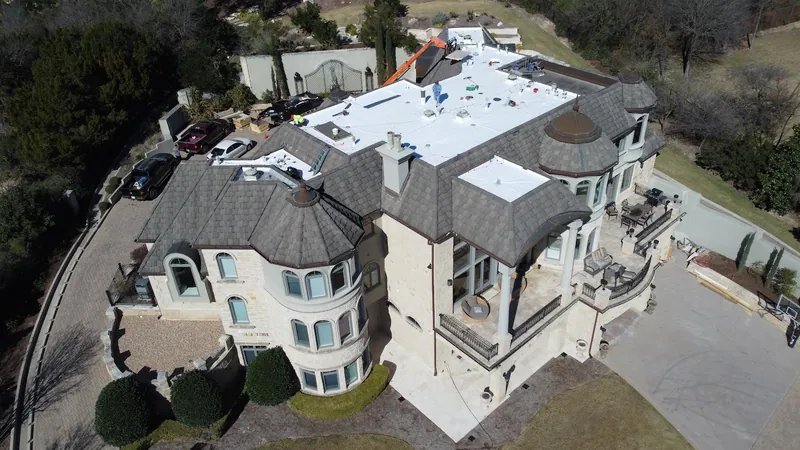
A lot of the low-slope work we see is on buildings that have both: a home or small building with shingle slopes over the main structure and flat sections over a porch, a garage, an addition or a wing. These roofs need both kinds of work done properly, and the transition where a flat section meets a shingle slope is a common place for leaks to start.
Because shingle roofs are our core work, these mixed roofs suit us well. We can inspect and quote the whole roof together, so one company is looking at the shingle slopes, the flat sections and the joints between them. See our asphalt shingle roofing and roof replacement pages for the pitched side of that work.
After Hail on a Commercial Roof
Hail damages low-slope roofs as well as shingles, and on a flat surface it can be just as hard to see from below. Rooftop equipment, metal edges and vents often show dents first. If a storm has hit your building, we inspect and photograph the roof the same way we do for homes. If you make an insurance claim, that claim is between you and your insurer; you can send them our photos, and if the work goes ahead we work from your adjuster's approved scope. Our hail and storm damage page explains what hail does to a roof.
Planning Roof Work on an Occupied Building
A roof over a business or over tenants is a different job from a roof over a single family. People are working, shopping or living underneath it while the work goes on, and the plan has to account for that.
Access and staging
We need a place to park, a way to get material onto the roof and a spot for the old material to go. On a small commercial lot or an apartment property, that can mean a few parking spaces set aside for the job. We work this out with you before the start date, not the morning of.
Tenants and customers
If you manage a property with tenants, it helps to tell them ahead of time when work will happen and what to expect: noise, trucks in the lot, crew on the roof. We give you the schedule so you can pass it along.
Rooftop equipment
Many low-slope roofs carry air conditioning units and other equipment. Replacing the roof around them can mean coordinating with whoever services that equipment. We flag it at the inspection so it is part of the plan from the start.
Records for the owner
Owners and managers often need a record of the roof's condition for their own files. The inspection photos, the written estimate and before-and-after photos of the finished work are yours to keep.
Who This Is For
- Homeowners with flat sections. Larger homes with low-slope areas over patios, wings or additions.
- Small commercial buildings. Offices, retail and similar buildings on a smaller scale.
- Multi-family properties. Duplexes, fourplexes and small apartment buildings.
- Owners and property managers. Anyone who needs to know what condition a roof is in, with photos to show for it.
If you manage a large building or a portfolio of properties, call us and describe the roof. We will tell you honestly whether it is a fit before anyone climbs a ladder.
Why Work With Viva Roofing
- Inspection first. Photos and a plain explanation before any estimate.
- A written estimate. You know the scope and the price before work begins.
- Honest about fit. If your building is outside what we do well, we say so.
- The owner is involved. Mike Zhukov stays personally involved, and customers name him for being responsive.
- Local and family-owned. Office in Frisco, working across Dallas-Fort Worth, Austin and San Antonio.