
You cannot see most of your roof from the ground, and the damage that matters most is often the hardest to spot. Hail bruises a shingle without breaking it. Wind breaks the seal on a shingle and it settles back down looking normal. A pipe boot cracks on the side of the roof that faces away from the street. A free inspection is how you find out what is actually up there, without having to climb a ladder or take anyone's word for it.
Viva Roofing offers free roof inspections to homeowners across Dallas-Fort Worth, Austin and San Antonio. We are a family-owned Texas company, working since 2021 from our office in Frisco. Every inspection comes with photos, so you see exactly what we see, and our reviews talk about Mike, the owner, showing customers their roof from the air with a drone.
There is no catch and no pressure. Some inspections turn up a roof that needs replacing. Some turn up a repair. Plenty turn up a roof that is in good shape, and when that is the case, we tell you so and you have photos showing it.
What We Check on a Roof Inspection
A useful inspection covers the whole roof system, not one slope. Here is what we look at and why each part matters.
Shingles on every slope
We look for hail hits, which show up as dark spots where granules have been knocked loose or as soft, bruised areas in the shingle mat. We look for creased or lifted shingles from wind, missing tabs, cracking, curling and cupping from heat, and broad areas of granule loss where the asphalt is exposed to the sun. We check each slope separately, because a storm that came in from one direction often hits one side of a roof much harder than the other.
Flashing
Where the roof meets a wall, chimney, dormer or skylight, metal flashing seals the joint. We check that it is seated, intact and not relying on cracked sealant to keep water out. Flashing is one of the most common sources of leaks on any roof.
Vents and pipe boots
Roof vents, exhaust vents and the rubber boots around plumbing pipes all get checked. The rubber on pipe boots dries and cracks in Texas sun, and hail can dent or crack vent caps. Metal vents are also a good indicator of hail: dents in soft metal help show the size and spread of a storm's hits.
Valleys, edges and ridge
Valleys carry more water than any other part of the roof, so worn or damaged shingles there matter more. We check the drip edge along the eaves, the ridge cap at the peak, and the gutters for heavy granule buildup, which tells us how quickly the shingles are wearing.
Signs of leaks and decking problems
Where the attic is accessible and you are comfortable with us looking, we check for water stains, damp insulation and dark wood on the underside of the decking. On the roof itself, a soft or spongy feel underfoot can mean moisture has been getting into the wood. Those findings help explain a ceiling stain and tell us whether the problem is a simple repair or something larger.
The Photos You Get
Photos are the point of the inspection. A roofer telling you there is damage is one thing; seeing it is another. After we inspect, we go through the photos with you and show you:
- Close-up shots of any damage we found, such as hail hits, lifted shingles, cracked boots or loose flashing.
- Wider shots that show where on the roof each problem is.
- Shots of areas that are in good shape, so you have a record of the roof's condition.
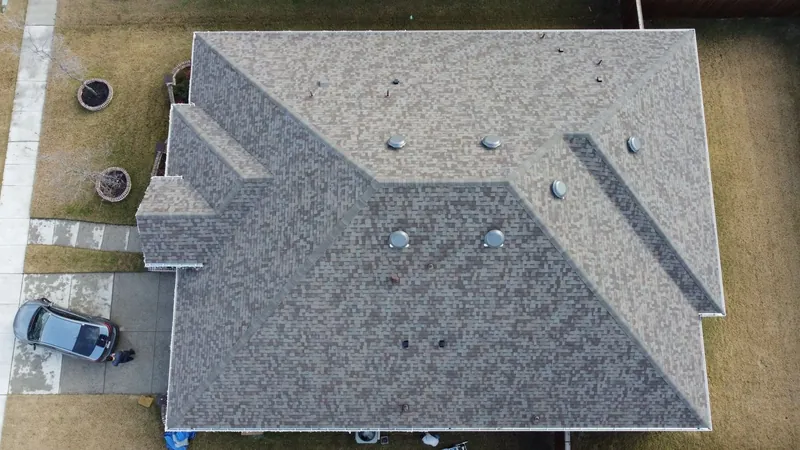
- Where we can fly it, a drone view of the whole roof, which shows slopes you will never see from your driveway.
The photos are yours to keep. You can use them to decide on a repair or a replacement, to get a second opinion, or to keep on file as a record of the roof's condition on that date.
When to Book a Roof Inspection
You do not need to wait for a leak. These are the moments when an inspection is worth setting up.
After any storm with hail or high wind
If hail fell in your neighborhood, or wind was strong enough to bring down branches or blow fence panels over, your roof took the same weather. Damage from those storms is often invisible from the ground, and the next section explains why sooner is better.
When you see something from inside
A new stain on a ceiling, a damp smell in a closet, peeling paint near the top of a wall, or daylight showing through boards in the attic all point to water getting in somewhere. The earlier the source is found, the smaller the fix tends to be.
When you find pieces of roof in the yard
Shingle tabs on the lawn, a pile of granules at the bottom of a downspout, or a strip of metal flashing in the flower bed are your roof telling you something has come loose.
When a neighbor is getting a new roof
If the house next door is having its roof replaced after a storm, yours very likely saw the same hail. It is worth knowing where your own roof stands, even if you decide to do nothing.
When the roof is getting older
Long Texas summers wear shingles down a little every year. If you do not know how old your roof is, or you bought the house and never had it looked at, a baseline inspection with photos tells you how much life it has left and gives you a record to compare against after the next storm.
What to Expect on Inspection Day
- A quick conversation first. We ask what prompted the call: a storm, a leak, a stain, or just wanting to know. If there is a problem inside, we look at that first.
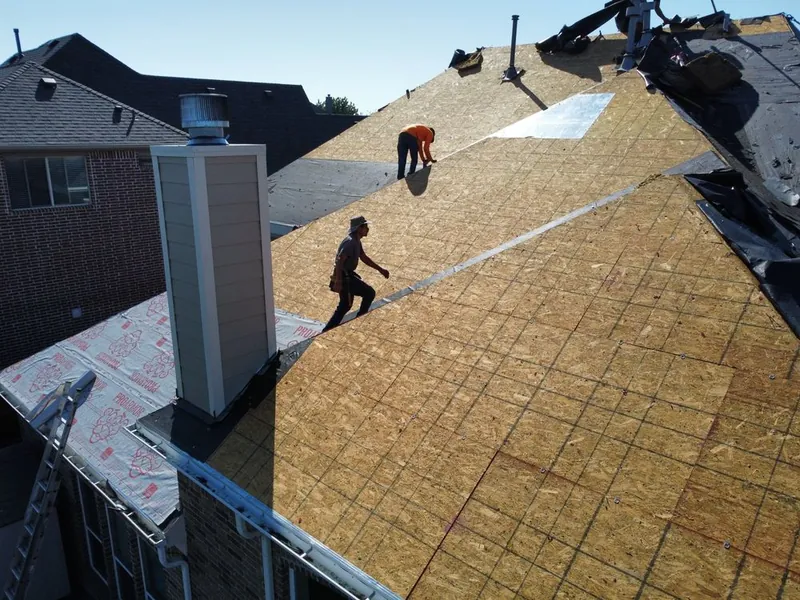
- The roof itself. We go up and check every slope, the flashing, vents, valleys, edges and ridge, photographing as we go. Where it makes sense, we fly the drone for a full overhead view.
- The attic, if you like. Where it is accessible and you are comfortable with it, we look at the underside of the decking for signs of water.
- We go over the photos with you. Not a stack of jargon: we show you each finding, explain what it means for the roof, and answer your questions.
- A clear next step. A repair estimate, a replacement estimate, or a plain "your roof is fine." You do not have to decide anything on the spot.
You do not need to prepare anything. If you have a ceiling stain or a spot you are worried about, it helps to point it out, and if there is a gate to the backyard, letting us know saves a knock on the door.
After Hail: Why Timing Matters
Hail damage is easiest to document when it is fresh. Right after a storm, hail hits on shingles show up clearly as spots where the granules were knocked away, and dents in vents and other soft metal are easy to photograph. As weeks and months go by, sun and rain weather those spots, and it becomes harder to tell new damage from ordinary wear. Bruised shingles also do not always leak right away. They can hold for a while and then crack, which means the damage was there long before the first drip.
That is why we suggest an inspection soon after any storm that dropped hail on your neighborhood, even if everything looks fine from the yard. On September 11, 2026, a hail storm hit northeast San Antonio, and homes in that area are the ones we most want to see this month. The same applies after any spring or fall hail in Dallas-Fort Worth or Austin.
Insurance: What the Inspection Does and Does Not Do
If we find storm damage, homeowners naturally ask about insurance, so here is exactly where we fit in. The inspection documents the condition of your roof with photos. That is all it does. Whether to file a claim is your decision, and the claim itself is between you and your insurance company.
If you decide to file, you file the claim with your insurer, and we provide the inspection photos for you to use. Your insurance company sends its own adjuster, who decides what the policy covers. If your adjuster approves a scope of work and you choose Viva Roofing to do it, we work from your adjuster's approved scope. We do not act on your behalf with your insurance company. You can read more about how that works on our insurance claim roofing page.
If the damage is minor, or you would simply rather pay for a repair yourself, that is your call too. The photos help either way.
What Happens After the Inspection
Every inspection ends one of three ways, and we will tell you plainly which one applies.
A repair
If the problem is limited to one area, such as a few shingles, a cracked pipe boot or a loose run of flashing, we give you a written estimate for the repair. See our roof repair page for what that involves.
A replacement
If the damage or wear is spread across the roof, we explain why we think a replacement is the better answer, show you the photos that led us there, and give you a written estimate. Our roof replacement page walks through the full process.
Nothing at all
If the roof is in good condition, we tell you that. You keep the photos, and you have a dated record of a healthy roof. We would much rather earn your trust on a roof that needs nothing than sell you work you do not need, and that honesty is what our customers mention most often in their reviews.
Why Homeowners Book an Inspection With Viva Roofing
- Free, with photos. The inspection costs nothing and you see everything we found.
- Drone views. Our reviews mention seeing the roof from the air, before and after.
- Honest results. If the roof needs nothing, that is what we tell you.
- You decide. Repair, replace, file a claim or do nothing: the choice is yours.
- Family-owned and local. A Texas company in Frisco since 2021, with the owner personally involved.
- 5.0 on Google. From 63 reviews by homeowners in Dallas-Fort Worth, Austin and San Antonio.