
A new roof is one of the biggest checks most homeowners ever write, and it is usually not a purchase anyone planned for. Maybe a spring storm went through, maybe the ceiling stain in the hallway came back after you patched it, or maybe you are selling and the buyer's inspector flagged the shingles. Whatever brought you here, the first thing you need is a straight answer about whether the roof actually needs replacing.
Viva Roofing is a family-owned Texas roofing company, working since 2021 out of our office in Frisco and serving Dallas-Fort Worth, Austin and San Antonio. Mike Zhukov, the owner, stays involved in the jobs, and that is the thing our customers mention most in their reviews: he answers the phone, explains what he sees in plain words, and does not try to sell a homeowner more roof than the house needs.
This page walks through how we decide a roof is due for replacement, what a tear-off looks like from the first shingle off to the final walk-through, the shingle options worth considering in a hail state, what goes into a written estimate, and how financing works if you would rather spread the cost out. If you already know you want someone to look at it, the inspection is free and you get the photos.
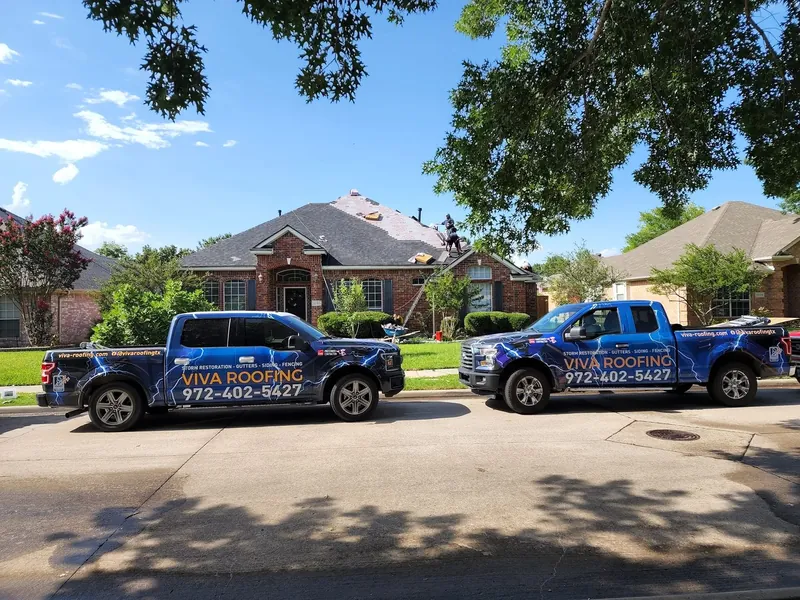
Signs Your Roof Needs Replacing, Not Another Repair
Texas is hard on a roof from two directions at once. Long summers bake asphalt shingles until they dry out and lose the granules that protect them from the sun, and spring and fall storms bring hail that cracks and bruises the shingle mat. A roof can look fine from the street for years while both of those things are happening. These are the signs we look for when we climb up.
Granule loss and bare spots
The colored granules on a shingle are its sunscreen. When they wash off in large amounts you start to see them collecting in gutters and at the bottom of downspouts, and on the roof you see dark, smooth patches where the asphalt underneath is exposed. Once that asphalt is taking direct sun, it ages quickly. A few scattered spots can be repaired. Wide areas of bare shingle across several slopes usually mean the roof has reached the end of its useful life.
Hail bruising across multiple slopes
Hail does not always leave a hole. More often it leaves a soft spot where the shingle mat has been crushed and the granules knocked loose. From the ground you will not see it, and in the first months it may not leak. Over time those bruises crack and let water in. When we find hail hits spread across every slope of the roof, rather than a handful in one area, patching individual shingles stops making sense, because the damage is everywhere the storm touched.
Curling, cupping and cracked shingles
Heat makes old shingles curl at the edges or cup in the middle. Curled shingles catch wind, and that is how a roof starts losing tabs in a storm. Cracking that runs across many shingles, especially on the south and west slopes that take the most afternoon sun, is another sign the roof is wearing out as a whole rather than failing in one spot.
Leaks that keep coming back
If you have had the same area repaired more than once and the stain on the ceiling keeps returning, the problem is often bigger than the spot being patched. Water can travel along the decking before it shows up inside, and an aging roof can develop new weak points faster than they can be fixed one at a time.
Sagging or soft decking
A roof line that dips between rafters, or decking that feels spongy underfoot, points to moisture that has been getting into the wood. That is a structural concern and it should be looked at soon. Replacement in that case includes replacing the damaged decking, which we can only fully see once the old shingles are off.
None of these signs on their own automatically means a new roof. That judgment comes from looking at the whole roof, and we would rather tell you a repair will hold for a few more years than sell you a replacement you do not need yet. If you are on the fence, our roof repair page lays out how we think about that choice.
How a Roof Replacement Works, Step by Step
Most homeowners have never watched a roof go on, so here is what actually happens. The photos below come from a single job, taken by drone at each stage, which is how we show customers their roof before, during and after.
1. Inspection and photos
Before anything is priced, we inspect the roof and photograph what we find: the shingles, the flashing around chimneys and walls, the vents, the valleys and the edges. You see the same photos we see. If the roof does not need replacing, we say so.
2. Written estimate and your choice of shingle
You get a written estimate that spells out the scope of work before anything starts. This is when you pick a shingle line and color. There is no pressure to sign the day we visit, and the estimate is the document we work from, so there are no surprises in what we are doing.
3. Tear-off down to the decking
On install day the crew protects the yard and landscaping around the house, then strips the old shingles, underlayment and worn flashing down to the wood decking. A tear-off lets us see the condition of the decking itself, which is the one thing nobody can judge from the top of an old roof. If we find soft or rotted boards, we show you photos and talk it through before that wood is replaced.
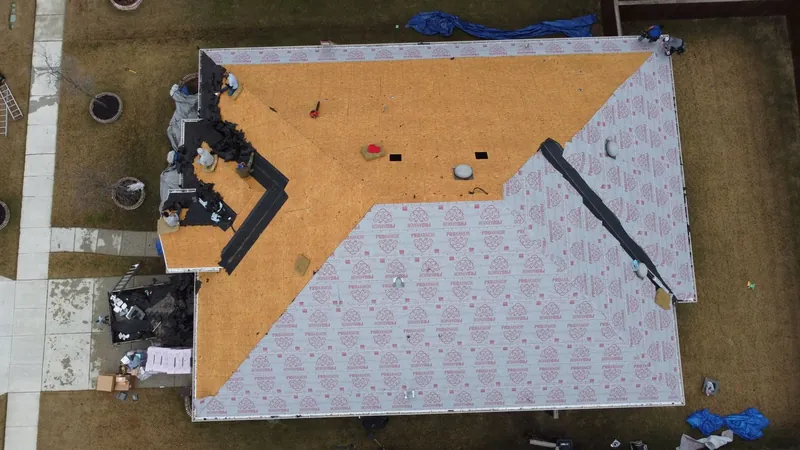
4. Underlayment over the whole roof
Once the decking is sound, the crew covers it with synthetic underlayment. This is the layer that sits between the wood and the shingles and acts as a second barrier against water. Drip edge goes along the eaves and rakes, and the valleys and other spots where water concentrates get extra attention, because those are where a roof is most likely to leak.
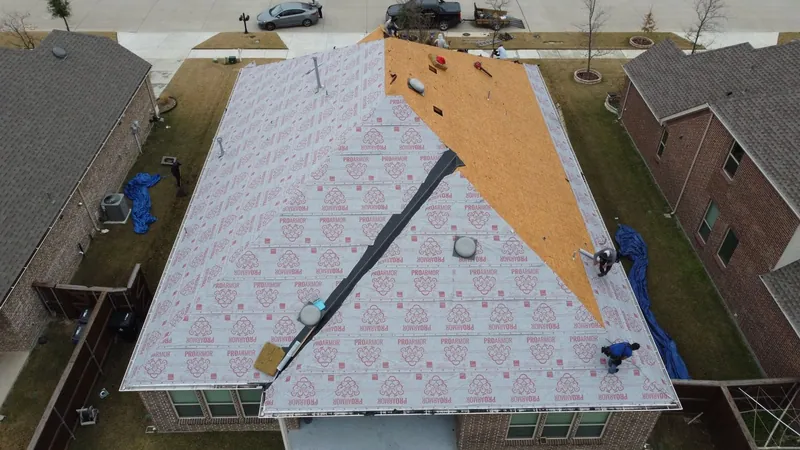
5. Shingles, flashing, vents and ridge
Shingles go on from the bottom edge upward, each course overlapping the one below it. New flashing is set where the roof meets walls, chimneys and other penetrations, and roof vents are installed so the attic can breathe. Ridge cap shingles finish the peak. Proper attic ventilation matters a great deal in a Texas summer, because a roof that traps heat in the attic ages faster from the underside.
6. Cleanup and the walk-through
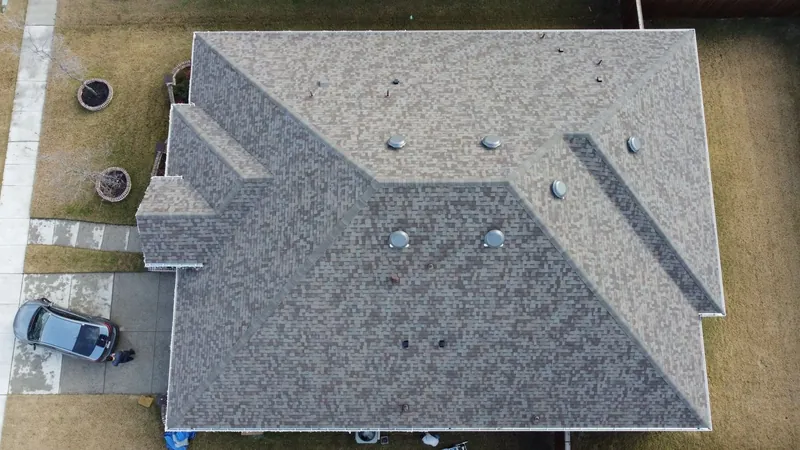
When the roof is on, the crew cleans up the debris from the yard, driveway and flower beds. Then we walk the job with you. We go over what was done, answer your questions, and show you the finished roof from the air with drone photos, the same angle as the before shots, so you can see the whole thing rather than the one slope visible from your driveway.
Shingle Options for a Texas Roof
Most homes we replace in Dallas-Fort Worth, Austin and San Antonio get asphalt shingles, and for good reason: they suit the climate, they look right on Texas brick and stone homes, and they come in a wide range of colors. Within asphalt there are real choices worth understanding.
Architectural shingles
Architectural, or dimensional, shingles are thicker than the old flat three-tab style and have a layered look that gives a roof more depth from the street. They are the standard choice on most replacements we do today. You can read more about colors and lines on our asphalt shingle roofing page.
Class 4 impact-resistant shingles
In a state where hail is a regular part of spring, many homeowners ask about impact-resistant shingles. Class 4 is the highest impact rating under the UL 2218 test, which drops steel balls onto the shingle to simulate hail. A Class 4 shingle is built to resist cracking from that kind of hit better than a standard shingle. It is not hail-proof, and no roof is, but it is an option we install and one of our customers specifically mentions in a review. If you are replacing a roof because of hail, it is worth asking about.
Metal roofing
Some homeowners decide to move away from shingles altogether. Metal is a different system with its own costs and benefits, and we cover it separately on the metal roofing page.
Whatever you choose, we will show you samples and talk through the trade-offs honestly. If a standard architectural shingle is the right fit for your house and budget, we will tell you that.
What Your Written Estimate Includes
The estimate is where you find out exactly what you are paying for, so we put it in writing before any work starts. A Viva Roofing estimate lays out:
- The scope of work: full tear-off and replacement, and which slopes or structures are included, such as a detached garage.
- The shingle line and color you chose.
- Underlayment, drip edge, flashing, vents and ridge cap.
- How replacement of any damaged decking is handled if we find it after tear-off.
- Cleanup and haul-away of the old roof.
If your roof was damaged in a storm and you have an insurance claim open, the claim is between you and your insurance company. You file the claim with your insurer, we provide the inspection photos, and once your adjuster has approved a scope, we work from that approved scope. Our insurance claim roofing page explains how that fits together.
Financing on Approved Credit
Not every roof replacement comes at a convenient time. If you would rather pay over time than all at once, financing is available on approved credit through a third-party lending partner. The terms come from the lender, not from us, and they depend on your application. Ask about it when we bring your estimate and we will show you how to apply. There is no obligation to finance, and it does not change the estimate or the work.
Why Homeowners Choose Viva Roofing for a Replacement
- Family-owned and local. We are a Texas company working out of Frisco since 2021, and Mike is personally involved in the work.
- Photos you can see. You get photos from the inspection and drone shots of the finished roof, so you are not taking anyone's word for it.
- Written estimate first. The scope and price are in writing before work begins.
- Fair pricing, no upselling. Our reviews say it better than we can: honest advice, and no extra charges added after the fact.
- Responsive. When you call, you get an answer, and when you have a question during the job, someone gets back to you.
- Rated 5.0 on Google. From 63 reviews by homeowners across Dallas-Fort Worth, Austin and San Antonio.
If you think your roof might be due, the easiest first step is a free roof inspection. We will tell you what we find and show you the photos, and you decide what happens next.