
Hail does not usually leave a roof looking wrecked. Most of the time the house looks exactly the same from the driveway the morning after a storm, and that is the problem. The damage that matters on an asphalt shingle roof is small, scattered and up high: bruised shingles, knocked-off granules, cracked tabs and lifted edges that you would only see standing on the roof with a trained eye.
Viva Roofing is a family-owned roofing company based in Frisco, working across Dallas-Fort Worth, Austin and San Antonio since 2021. A lot of our work is restoring roofs after hail, which is a fact of life in this part of Texas. When a storm rolls through, we get up on the roof, photograph what we find, and show you the pictures so you can decide what to do next with real information instead of a guess.
The inspection is free. You get the photos whether or not you hire us. If the roof came through fine, we tell you that, and you have a dated set of pictures of a healthy roof to keep on file. If it did not, we walk you through what is damaged, what it means, and what a repair or a replacement would involve, with a written estimate before any work starts.
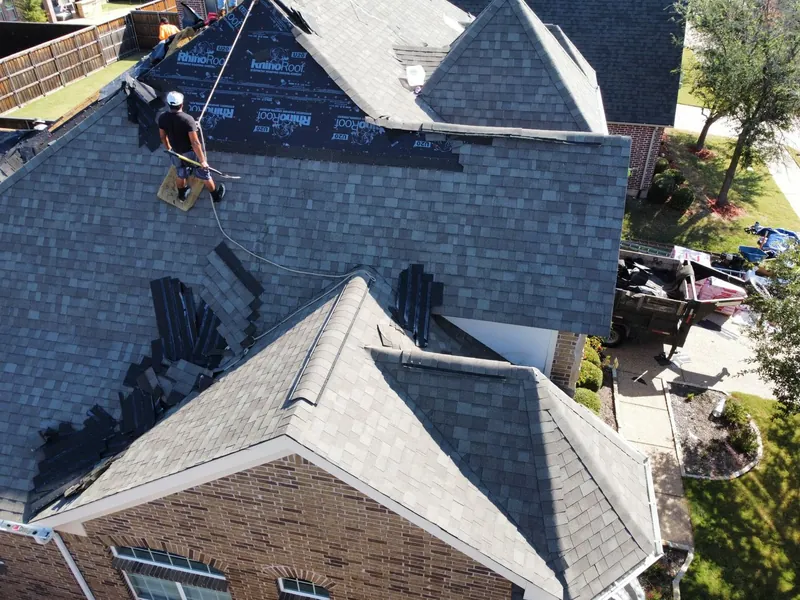
What Hail and Wind Actually Do to a Shingle Roof
An asphalt shingle is a mat (fiberglass on modern shingles) coated in asphalt and topped with a layer of mineral granules. The granules are not decoration. They shield the asphalt from the sun, and the asphalt is what keeps water out. Storm damage is any hit that breaks one of those layers.
Hail: bruises, granule loss and cracks
When a hailstone strikes a shingle, it can knock the granules loose in a round patch and leave the asphalt underneath exposed. Harder hits push a soft dent into the shingle, often called a bruise. If you press on a bruise it can feel spongy, because the mat underneath has been fractured even though the surface did not split. A bruise does not leak the next day. It leaves a weak spot that the sun, heat and rain work on over the next seasons until it does.
The heaviest hits crack the shingle outright, and the larger the hail, the more likely you are to see broken tabs and punctures on the slopes that faced the storm. Hail also dents the softer metal on and around a roof: vents, flashing, gutters and downspouts, and the fins on an outdoor air conditioning unit. Those dents are often the first sign a homeowner spots, and they are a good reason to have the shingles looked at.
Wind: lifted, creased and missing shingles
Wind damage looks different. Shingles are held down by nails and by an adhesive strip that seals each course to the one below. A strong gust can break that seal and lift the shingle, and when the shingle bends back too far it creases across the top. A creased shingle may lie flat again once the wind stops, so it looks fine from the ground, but it no longer seals and the next storm is likely to peel it off. Missing shingles, exposed nail heads and debris lying on the roof are the more obvious signs.
Why you cannot judge it from the yard
Granule loss and bruising are small, they sit on a dark surface, and they are spread across a roof you are looking at from a low angle. From the street, a roof with real hail damage and a roof with none can look identical. That is why we do not quote off a photo taken from the curb. We go up, mark and photograph the hits, and where the roof allows it we take drone photos so you can see the whole surface yourself. Our customers mention those drone pictures in their reviews more than almost anything else, because seeing your own roof from above makes the conversation simple.
Signs worth calling about
- Dented metal. New dings in gutters, downspouts, roof vents or the outdoor AC unit after a storm.
- Granules where they should not be. Dark, sand-like grit collecting in gutters or washing out of the downspouts.
- Shingles on the ground. Pieces of shingle in the yard, or a patch of the roof that looks a different color.
- Water inside. A new stain on a ceiling, or damp insulation in the attic after rain.
- The neighbors are getting new roofs. Hail tends to hit a whole street at once. If the houses around you are being inspected, yours probably took the same storm.
How a Storm Inspection Works
1. You call or send the form
Tell us where the house is and what you saw, if anything. Plenty of people call with nothing more than "the hail was loud last night." That is enough. We set a time to come out.
2. We inspect and photograph the roof
We look at every slope, the ridge, the flashing around chimneys and walls, the vents and pipe boots, and the gutters. We photograph what we find, both close up and wide, so you can tell which part of the roof each picture came from. On many homes we add drone photos of the whole roof.
3. We show you the photos and explain them
You see what we saw. We point out the hits, tell you whether we think they are storm damage or ordinary wear, and say plainly when a roof is fine. Not every roof that sat under a hail storm needs work, and we would rather tell you that than sell you something you do not need.
4. You decide what to do next
If there is damage, you get a written estimate for the repair or the replacement. If you plan to make an insurance claim, the photos are yours to send to your insurer. The claim is between you and your insurance company: you file it, their adjuster inspects, and if the work goes ahead we work from your adjuster's approved scope. Our insurance claim roofing page explains how that process looks from your side.
Repair or Replacement After a Storm?
Both are real answers, and the right one depends on what the inspection finds.
When a repair makes sense
Wind that tore off a handful of shingles on one slope, a damaged vent, a lifted ridge cap or a single area of impact damage can often be repaired. We replace the damaged shingles and any flashing or vents that took hits, and match the existing roof as closely as the available shingles allow. See our roof repair page for more on what a repair involves.
When a replacement is the honest answer
When hail has bruised shingles across most of the roof, patching individual shingles does not fix the problem, because every slope is carrying the same hidden damage. The same goes for an older roof where the shingles are brittle enough that walking on them to make a repair breaks more than it fixes. In those cases a full roof replacement is the repair that lasts. We tear off down to the decking, replace any decking that is soft or damaged, put down new underlayment and install new shingles.
Choosing a tougher shingle
If you are replacing a roof in hail country, ask about Class 4 impact-resistant shingles. Class 4 is the highest rating under the UL 2218 impact test, in which a 2-inch steel ball is dropped onto the shingle from 20 feet. No shingle is hail-proof, but a Class 4 shingle is built to take a harder hit than a standard one. Customers have chosen this option with us, and we can quote it alongside a standard architectural shingle so you can compare.
The September 2026 Hail in San Antonio
On September 11, 2026, a hail storm hit northeast San Antonio. We work in San Antonio and the neighboring cities of Schertz, Cibolo and Converse, and we are inspecting roofs there now. If your home was under that storm, a free inspection will tell you whether the roof took damage, and the photos give you a dated record either way. Read more on our San Antonio roofing page.
Why Homeowners Call Viva Roofing After a Storm
- Photos of everything. You see your own roof, close up and from the drone, before anyone talks about money.
- A straight answer. If the roof is fine, we say so. Our reviews come back to the same thing: honest, fair pricing, no upselling.
- The owner is involved. Mike Zhukov, the owner, stays personally involved in the jobs, and customers mention by name how responsive he is.
- A written estimate first. You know what the work covers before it starts.
- Local and family-owned. A Texas company with an office in Frisco, rated 5.0 on Google from 63 reviews.
- Financing available. On approved credit through a third-party lending partner, if paying all at once does not suit you.
Where We Inspect Storm Damage
In Dallas-Fort Worth we work out of Frisco and cover Frisco, Plano, McKinney, Allen, Prosper, Little Elm and Dallas. We also work in Austin and across the San Antonio area. Not sure whether we come to your street? Call us and ask.