
Sources: This Old House, TPO roofing guide, updated June 5, 2026; reflectance from Elevate's UltraPly TPO technical sheet (CRRC rating), July 2, 2026.
A TPO roof is a flat or low-slope roof covered with a single layer of thermoplastic polyolefin, a flexible membrane made from a blend of synthetic rubber and polypropylene. It comes in wide rolls, usually white, and the seams are welded with hot air so the sheets fuse into one continuous waterproof surface. This Old House puts its life at 15 to 30 years with proper care, and the white surface reflects much of the sun, which is why TPO is so common on flat roofs in Texas.
This guide explains what a TPO roof is made of, how it goes on, where it tends to fail, what it costs and how it compares with EPDM and PVC. If you own a small commercial building, a fourplex or a home with flat sections over a patio or wing, our commercial and low-slope roofing page covers how we inspect and quote that kind of roof.
In this guide
- What TPO roofing is made of
- How a TPO roof is installed
- Why TPO suits a Texas flat roof
- The downsides of TPO roofing
- TPO vs. EPDM vs. PVC
- What a TPO roof costs
- When to call about a flat roof
- TPO roof questions
What TPO roofing is made of
TPO stands for thermoplastic polyolefin. "Thermoplastic" is the important word: the material softens when heated and hardens again when it cools, which is what lets two sheets be welded together. This Old House describes TPO as a single-ply, white mixture of synthetic rubber and polypropylene that repels moisture and resists heat, oxidation and weather.
Reinforced TPO sheets have a polyester scrim sealed inside the membrane for strength. Elevate's UltraPly TPO technical sheet (July 2, 2026), for example, describes a membrane with polyester weft-inserted reinforcement that meets ASTM D6878, the industry standard specification for TPO roofing sheet. Ask for that standard by name on any quote.
Thickness: 45 mil and 60 mil
TPO thickness is measured in mils, or thousandths of an inch. The UltraPly sheet lists 45 mil (1.14 mm) and 60 mil (1.52 mm). Thicker sheet costs more and gives more material to weather away before the reinforcement is exposed. When you compare two TPO bids, check that both name the same thickness, because a 45 mil bid and a 60 mil bid are not the same roof.
How a TPO roof is installed
A TPO roof is a system, not just a sheet. In broad strokes, a replacement goes like this:
- Tear-off and deck check. The old surface comes off and the deck underneath is checked. Wet insulation or damaged decking gets replaced, because a membrane laid over wet material traps it.
- Insulation or cover board. Rigid board goes down over the deck. The manufacturer's instructions call for a substrate that is clean, dry, smooth and free of sharp edges, and for gaps wider than a quarter inch to be filled.
- Membrane. The rolls are laid out with overlapping side and end laps, then fastened or adhered to the roof. This Old House describes securing the membrane with fasteners and sealing it with a hot air gun.
- Heat-welded seams. A hot-air welder melts the overlap so the two sheets fuse into one. A weld that was rushed or run too cool is where a leak starts.
- Flashing and details. Walls, parapets, curbs under air conditioning units, drains, vents and pipes all get flashed with TPO pieces welded to the field sheet.
Can TPO go straight over plywood? On most buildings it goes over insulation or cover board, not bare wood, and the right substrate depends on the specific manufacturer's system and warranty requirements. That is a question for the inspection, not a guess.
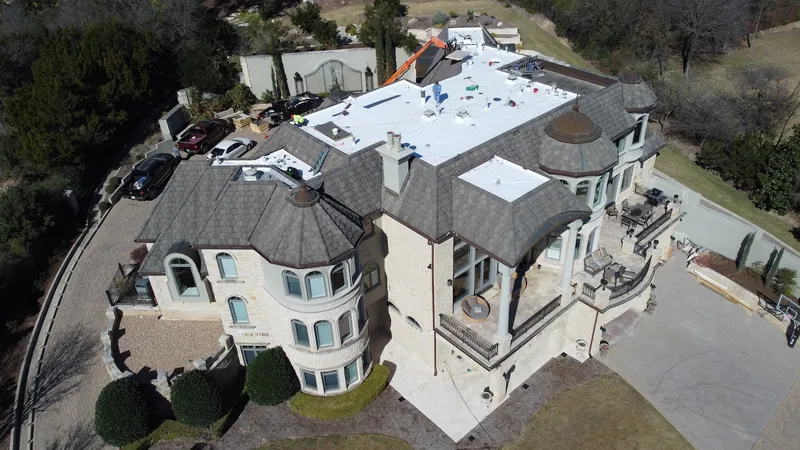
Why TPO suits a Texas flat roof
A flat roof takes direct sun all day with no shade from its own slope. A white membrane sends a large share of that sunlight back. The Cool Roof Rating Council values printed on the UltraPly sheet show the white membrane reflecting 79% of sunlight when new and 69% after three years of weathering. The gray version of the same product reflects 34%.
Less heat soaking into the roof means less heat moving into the space below, which matters over an office, a shop or a bonus room through a Texas August.
That reflectance does drop as the roof gets dirty, which is the 79% to 69% change, so an occasional cleaning keeps a white roof working. The membrane's flexibility also helps with the swing between a hot afternoon and a cool night, which works the seams of stiffer roof types.
The downsides of TPO roofing
TPO is a good roof, not a perfect one. Here is what to know before choosing it.
- It lives or dies by its seams. The welds and the flashing details are where TPO roofs usually give trouble: seams that were not welded fully, flashing at walls and equipment curbs, and the transition to any shingle slope on the same building.
- Punctures. A single ply is thin. Foot traffic, dropped tools and hail can puncture it. Many punctures can be repaired by cleaning the membrane and welding a patch over the spot.
- A shorter track record. This Old House notes TPO is relatively new compared with EPDM and PVC, so it has less history behind it.
- Looks. A white membrane is fine on a flat roof nobody sees. It is not meant for a visible slope on the front of a house.
Is it safe to walk on a TPO roof? Yes, with care. Wet TPO is slippery, and boots with grit or sharp debris on them can scratch or puncture the surface. On roofs with equipment that gets serviced, a walkway path keeps technicians off the open membrane.
TPO vs. EPDM vs. PVC
These are the three single-ply membranes you are most likely to see on a quote for a low-slope roof.
| Membrane | What it is | Seams | Typical life |
|---|---|---|---|
| TPO | White thermoplastic, rubber and polypropylene blend | Heat-welded | 15–30 years |
| EPDM | Synthetic rubber, usually black | Tape or adhesive | Around 30 years |
| PVC | Thermoplastic vinyl membrane | Heat-welded | Longest record of the three |
Source: life and comparisons, This Old House, updated June 5, 2026.
This Old House calls EPDM slightly more weather-resistant, while TPO resists oil and grease better, which counts near restaurant exhaust or rooftop equipment. PVC has the longest track record of the welded membranes, and the guide describes TPO as slightly stronger. In practice, the dark surface is EPDM's biggest drawback in Texas, since it absorbs more heat than a white sheet. Modified bitumen, an asphalt-based roof laid in layers, is the other option you will see on older flat sections.
What a TPO roof costs
This Old House gives TPO at $4 to $10 per square foot, citing HomeGuide and Angi, and a national average of about $10,700 for a 1,500-square-foot roof. The real number depends on tear-off, how much wet insulation has to come out, the membrane thickness, how it is attached, and how many curbs, drains and walls need flashing.
One Texas detail changes the math on commercial buildings. The Texas Comptroller treats the total charge for repairing or remodeling nonresidential real property as taxable, while labor on residential property is not. So a TPO roof over a shop or office carries sales tax that the same roof over a home's patio wing would not.
When to call about a flat roof
Call for an inspection when you see water sitting in the same low spot days after every rain, blisters or splits in the surface, seams that have lifted, stains on a ceiling under a flat section, or dents on rooftop equipment and metal edges after hail. On a flat roof, water can travel before it shows up inside, so the stain is not always under the problem.
Here is how a low-slope inspection from Viva Roofing works:
- We walk the roof and photograph it. The field of the roof, the seams, edges and flashing, the drains and every penetration, with drone photos of the whole roof where the building allows.
- You get the photos whether or not you hire us. We walk you through them, and if a building is outside what we can do well, we tell you at the inspection.
- Repair first. A sound roof with a few failed seams or a leaking penetration can often be repaired, and that is the first thing we look for.
- Options in writing. When replacement makes sense, we can quote TPO and the other low-slope options for your building and explain why one fits.
We are a family-owned roofing company with an office in Frisco, working across Dallas-Fort Worth, San Antonio and Austin since 2021. We inspect flat and mixed roofs from McKinney, Prosper and Little Elm to Schertz and Cibolo. To find out what your flat roof needs, see our commercial roofing page or request a free inspection.
TPO roof questions
What is a TPO roof?
A TPO roof is a flat or low-slope roof covered with a single layer of thermoplastic polyolefin, a flexible membrane made from synthetic rubber and polypropylene. It usually comes in white rolls, and the seams are welded with hot air into one continuous surface.
What does TPO stand for?
Thermoplastic polyolefin. Thermoplastic means the material softens when heated and hardens as it cools, which is what lets roofers weld the seams instead of gluing them.
How long does a TPO roof last?
This Old House gives 15 to 30 years with proper care. Membrane thickness, how well the seams were welded, foot traffic and hail all affect where a roof lands in that range.
What are the downsides of TPO roofing?
Its seams and flashing details are where it usually fails, a single ply can be punctured by foot traffic, dropped tools or hail, and it has a shorter track record than EPDM or PVC. It is also not meant for a visible slope on a house.
Is it safe to walk on a TPO roof?
Yes, with care. Wet TPO is slippery, and grit or sharp debris on boots can scratch or puncture the membrane. Roofs with equipment that gets serviced do best with a walkway path.
Can TPO be installed over plywood?
On most buildings TPO goes over rigid insulation or cover board rather than bare wood, and the substrate has to be clean, dry and smooth. The right base depends on the manufacturer's system, so it should be specified at the inspection.
How much does a TPO roof cost?
This Old House gives $4 to $10 per square foot and a national average of about $10,700 for a 1,500-square-foot roof. Tear-off, wet insulation, thickness and the number of flashing details move the price, and commercial jobs in Texas carry sales tax.