
Source: This Old House, standing seam metal roof cost (RSMeans data from Gordian), updated March 31, 2026. Roof area, not floor area.
A standing seam metal roof costs about $8 to $39 per square foot installed, according to This Old House's 2026 cost guide. That works out to roughly $800 to $3,900 per square (100 square feet), or about $15,000 to $79,000 for a 2,000-square-foot roof. Steel sits at the low end of that range and copper and zinc at the top. Where your house lands depends on the metal, the panel gauge, the finish and how cut-up your roof is.
This guide breaks down standing seam metal roofing prices so the number on a quote makes sense: what the national ranges include, how standing seam compares with exposed-fastener metal and shingles, and what drives the price up or down on a North Texas home. If you are already comparing options for your own house, our metal roofing page covers the two panel systems in plain terms.
In this guide
- Standing seam cost per square foot and per square
- Standing seam vs. exposed-fastener metal vs. shingles
- What drives standing seam metal roofing pricing
- Hail, heat and insurance in North Texas
- Is standing seam worth the price?
- What goes into a quote from us
- Standing seam roof cost questions
Standing seam cost per square foot and per square
Roofers price by the square, which is 100 square feet of roof. National guides mostly quote by the square foot. Multiply a per-square-foot price by 100 to get a per-square price, and remember that your roof's area is larger than your home's floor area once you add overhangs and pitch.
This Old House's guide, built on RSMeans construction cost data from Gordian, gives these installed ranges for a standing seam metal roof:
| Roof size | Low end | High end |
|---|---|---|
| 1,000 sq ft (10 squares) | $7,540 | $39,430 |
| 1,500 sq ft (15 squares) | $11,310 | $59,145 |
| 2,000 sq ft (20 squares) | $15,080 | $78,860 |
| 2,500 sq ft (25 squares) | $18,850 | $98,575 |
| 3,000 sq ft (30 squares) | $22,620 | $118,290 |
Source: This Old House, updated March 31, 2026.
That spread is wide because it covers every metal. In the same guide, steel runs about $4.59 to $8.55 per square foot, while aluminum and zinc reach $28.50 and copper $26.60. So a painted steel standing seam quote should sit in the lower part of the overall range, not the middle.
You will also see much lower numbers online. Bob Vila's metal roof cost guide (updated July 2022) lists standing seam at $200 to $1,000 per square. Read the fine print: that guide prices labor separately and says labor can run three to seven times the cost of the materials. A materials-only price per square and an installed price per square are different numbers, and comparing one to the other is the most common reason a quote looks "too high."
Standing seam vs. exposed-fastener metal vs. shingles
Most homeowners asking about the price of a standing seam metal roof are weighing it against two cheaper options: exposed-fastener metal panels (screwed through the face) and asphalt shingles.
| Roof type | Installed cost | Expected life |
|---|---|---|
| Standing seam metal | $8–$39 per sq ft | 50–80 years |
| Exposed-fastener metal | About a third less than comparable standing seam | Depends on screw and washer upkeep |
| Asphalt shingles | $3.44–$12 per sq ft | 15–30 years |
Sources: standing seam cost and life, This Old House (March 31, 2026); exposed-fastener comparison, McElroy Metal (May 2022); shingle cost, This Old House (March 12, 2026).
Panel manufacturer McElroy Metal puts standing seam at roughly 50% more than a comparable exposed-fastener system of the same gauge. Part of that is the panel itself: standing seam panels usually cover 16 to 18 inches each, where exposed-fastener panels routinely cover 36 inches, so a standing seam roof takes more pieces, more seams and more labor. They also ship in wooden crates on their side instead of stacked flat.
What the extra money buys is the hidden fastener. On standing seam, the clips that hold the panels down sit under the raised seam, out of the weather. On an exposed-fastener roof, every screw goes through the panel with a rubber washer to seal it, and those washers age in the sun.
What drives standing seam metal roofing pricing
Two houses of the same size can get very different standing seam quotes. These are the line items that move the number.
Steel or aluminum
Steel is the budget choice for standing seam. Steel roofing panels are often Galvalume, a steel sheet with a 55% aluminum-zinc alloy coating for corrosion protection; steel producer Wheeling-Nippon names metal roofing as one of its most common uses. Aluminum costs more per square foot, and copper and zinc are architectural metals with prices to match.
Panel gauge
Gauge is panel thickness, and a lower number means thicker metal. Residential standing seam is usually 24 or 26 gauge, according to both McElroy Metal (June 2025) and Bob Vila. McElroy's rule of thumb is that material cost rises about 20% per gauge step. Thicker panels also show hail dents less, which matters here.
Panel profile: snap-lock or mechanical lock
Snap-lock panels click together and install faster. Mechanical-lock panels are folded shut on the roof with a hand or electric seamer, which This Old House notes takes more time and labor. Panel width plays in too: wider panels mean fewer seams and usually a lower price.
Paint finish
Painted steel comes with one of two common finish families. SMP (silicone-modified polyester) is the cheaper one. PVDF, sold under names like Kynar 500, costs more but holds its color longer and comes in more cool-roof rated colors, per This Old House. In Texas sun, fading is a real consideration on a roof meant to last decades.
Roof shape
Long, simple slopes are the cheapest to cover with standing seam. Every valley, hip, dormer, skylight and vent pipe needs custom-bent trim and flashing, and each one adds labor. A cut-up roof can cost noticeably more per square than a simple gable of the same size.
Tear-off and decking
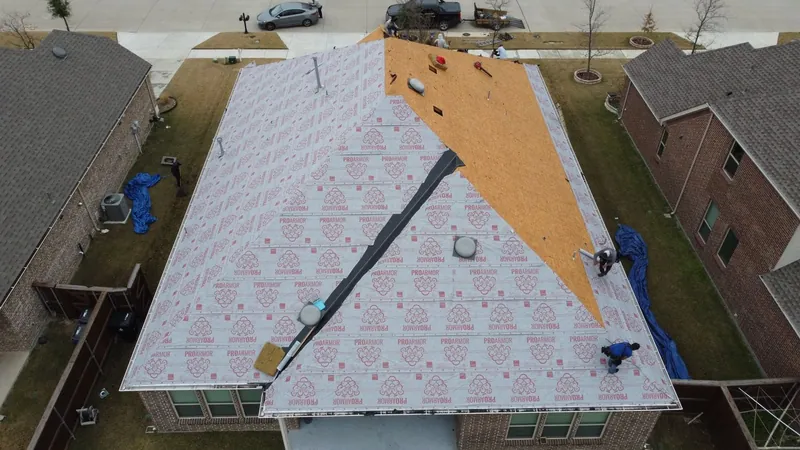
Removing the old roof is usually part of the installed price; This Old House notes most roofers include tear-off of the old roof and felt. What cannot be priced until the old roof is off is the decking underneath. Soft or rotted boards have to be replaced before any new roof goes on, metal or shingle.
Hail, heat and insurance in North Texas
Texas had more major hail events than any other state in 2025, 902 of them, according to the Insurance Information Institute, citing NOAA data. That shapes how a metal roof should be priced and chosen around McKinney, Prosper, Frisco and Little Elm.
Class 4 impact ratings
Impact resistance is tested under UL 2218. For the top rating, Class 4, a 2-inch steel ball is dropped from 20 feet, and the roofing must show no tearing, cracking, splitting or other opening, as McElroy Metal explains. The rating belongs to the specific tested product, so ask for it by product name on any quote.
Class 4 does not mean hail-proof. The test is about the roof staying watertight; a standing seam panel can still dent in a big storm, and dents show most on smooth, light-colored panels.
Insurance discounts
The Texas Department of Insurance says the discount for an impact-resistant roof is set by each insurance company, with Class 4 earning the largest credit. To qualify, the product must be tested and labeled under UL 2218 or another standard your insurer accepts, and your insurer may ask for the installer's paperwork, such as TDI form PC068. Call your agent before you sign, ask what credit a Class 4 metal roof would earn on your policy, and ask how cosmetic hail dents are handled. That answer can change the real cost of the roof over the years you own it.
Heat
A light or reflective finish sends back more sunlight than a dark shingle, which can mean a cooler attic in a long Texas summer. Color and coating matter more than the metal itself, and attic ventilation still does much of the work.
Is standing seam worth the price?
It depends mostly on how long you plan to own the house. At 50 to 80 years of expected life against 15 to 30 for asphalt, per This Old House, standing seam can outlast two or three shingle roofs. If you expect to sell in a few years, a good impact-resistant shingle usually returns more of its cost. If this is the house you plan to keep, standing seam deserves a serious look, and the higher price is spread over a much longer life.
The other thing it buys is less upkeep than an exposed-fastener roof, with no screws through the panel face to check and replace over the years.
What goes into a quote from us
We do not publish prices on this site, because the cost of a metal roof depends on the house. Here is what a metal roofing quote from Viva Roofing covers:
- A free inspection. We look at the current roof, the decking where we can see it and the attic ventilation, and photograph what we find.
- A written estimate. The panel system, gauge, finish, color and full scope are in writing before any work starts.
- Metal and shingle side by side. We install both, so if you want a shingle price on the same house, we include it and the difference is a real number.
- Financing, if you need it. Financing is available on approved credit through a third-party lending partner. Ask when you get your estimate.
We are a family-owned roofing company with our office in Frisco, working across Dallas-Fort Worth, San Antonio and Austin since 2021. Homeowners near Plano and Allen get the same inspection, and we also have local pages for metal roofing in San Antonio and metal roofing in Austin. To get a standing seam price for your own roof, request a free inspection.
Standing seam roof cost questions
How much does a standing seam metal roof cost per square foot?
About $8 to $39 per square foot installed, according to This Old House's 2026 cost guide, which uses RSMeans data. Steel sits at the low end of that range; aluminum, zinc and copper push toward the top. Roof shape, panel gauge and finish move the price within it.
How much is standing seam per square?
A roofing square is 100 square feet, so This Old House's installed range works out to about $800 to $3,900 per square. Lower per-square figures you see online, such as $200 to $1,000, are usually material prices with labor counted separately.
What does a standing seam roof cost for a typical home?
For a 2,000-square-foot roof, This Old House puts the installed range at $15,080 to $78,860. Measure roof area, not floor area: overhangs and pitch make the roof larger than the house's footprint.
Is standing seam more expensive than exposed-fastener metal?
Yes. Panel maker McElroy Metal estimates standing seam at roughly 50% more than a comparable exposed-fastener system of the same gauge, because the panels are narrower, take more labor and ship in crates. The trade is hidden fasteners instead of screws through the panel face.
Does a Class 4 metal roof lower insurance in Texas?
It can. The Texas Department of Insurance says each insurer sets its own discount for impact-resistant roofing, with UL 2218 Class 4 earning the largest credit. Ask your agent what credit your policy gives and how it treats cosmetic hail dents before you choose a roof.
Is a standing seam metal roof hail-proof?
No roof is. A Class 4 rating means the tested product did not crack, split or open when hit with a 2-inch steel ball dropped from 20 feet. Metal panels can still dent in a large hailstorm, and thicker or textured panels show dents less.
How long does a standing seam metal roof last?
This Old House gives 50 to 80 years for standing seam, against 15 to 30 years for asphalt shingles. That longer life is the main argument for paying more up front if you plan to stay in the house.